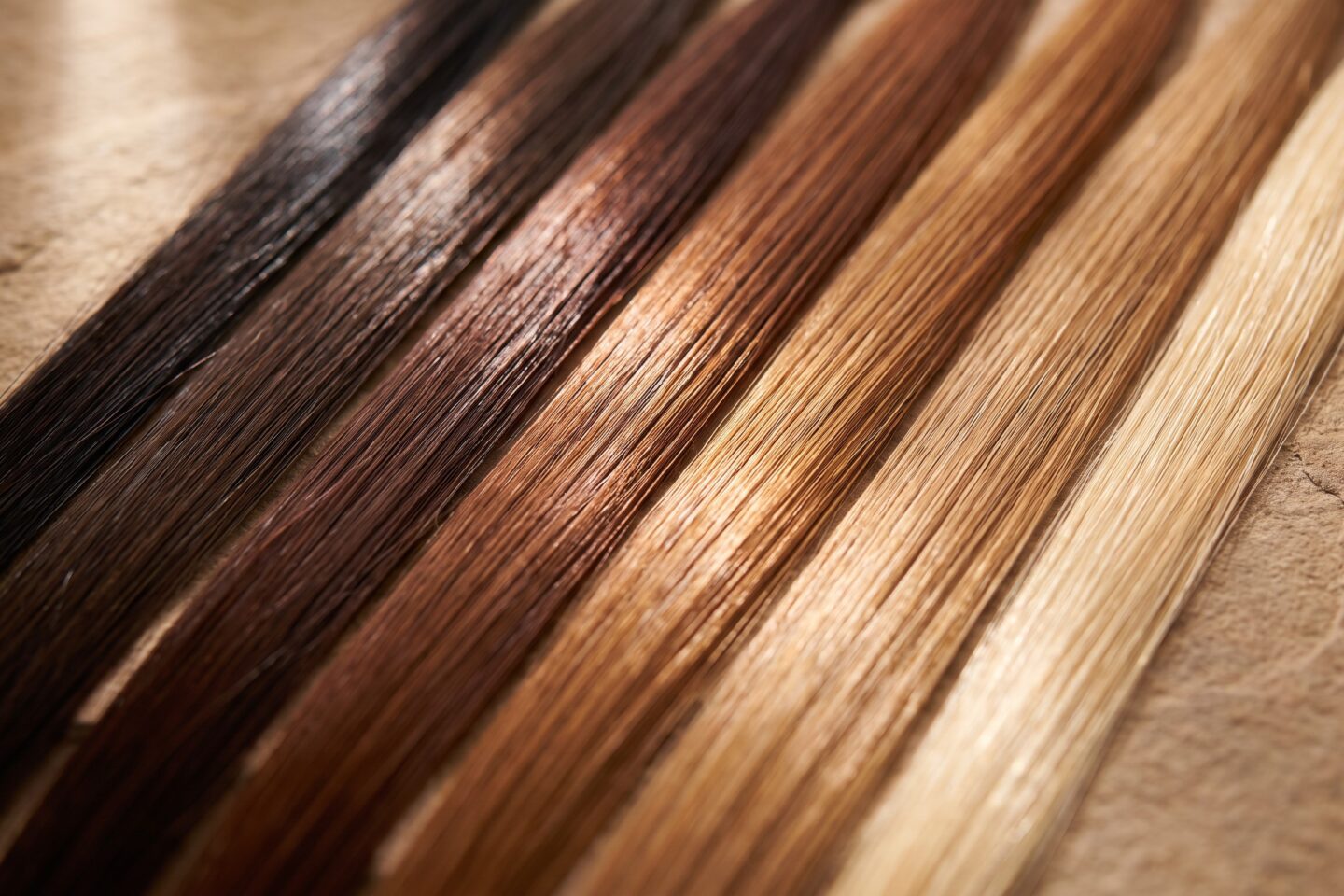
Seven shades sounds like a small number until you are looking at them. It is a deliberate range: enough to sit properly against most complexions, few enough that every one is cut from real light rather than invented on a screen. Here is how they run, and how to narrow seven down to one without guessing.
The range, darkest to lightest
- Espresso Obsidian — near-black with a cool cast. Reads as true black indoors, shows depth in daylight.
- Cognac Tourmaline — deep brown with a red undertone that surfaces in sun.
- Cocoa Zircon — a neutral dark brown. The safest shade in the range and the most forgiving against a regrowth line.
- Bronzite Luster — mid brown carrying warmth without going copper.
- Sunstone Roast — warm chestnut, the most obviously sunlit of the darks.
- Champagne Topaz — soft beige blonde, cool enough to avoid brass.
- Golden Citrine — the lightest, warm and honeyed.
Start with undertone, not colour
Most mismatches are not too light or too dark. They are too warm or too cool. Two quick tests, both done in daylight:
Jewellery. If gold flatters you more than silver, you lean warm — Cognac Tourmaline, Sunstone Roast, Golden Citrine. If silver wins, you lean cool — Espresso Obsidian, Champagne Topaz. If both look fine, you are neutral, and Cocoa Zircon or Bronzite Luster will sit easily.
White against cream. Hold a white sheet of paper, then a cream one, near your jaw. Whichever makes your skin look healthier rather than grey points the same way: white for cool, cream for warm.
Match your roots, not your ends
Ends have been in the sun, and often through colour. Roots are your actual base. A piece matched to sun-lifted ends reads as a wig at the parting, which is the one place people look.
Judge it in daylight, near your face
Shop lighting flatters and phone screens lie. Take the shade to a window and hold it against your hairline and jaw — not your hand, which is usually a different tone entirely. Look at it for longer than feels necessary, and look at it moving.
When you are between two
Go darker. A shade slightly deeper than your own reads as intentional and grows softer against the skin; a shade too light reads as separate from you. Depth is easy to live with. Brightness is not.
The shortcut
Order the Shade Swatch Kit. Seven cuticle-aligned swatches of the real hair, in your hands, in your own light, against your own skin — which settles in ten minutes what a screen cannot settle at all. If none of the seven is right, custom colour work is possible; it adds about ten business days to the build.
And if you would rather not decide alone, book a fitting. Bringing a shade decision to someone who does it daily is not a shortcut. It is the reason the parting looks like a parting.